Why consistent legal names matter across your California estate plan
A name mismatch may seem minor, but it can create real delays when a family needs to verify ownership, transfer property, administer a trust, or begin probate. For San Francisco Bay Area families, reviewing how your name appears across key records can make your estate plan easier to understand and administer later. This is especially important when documents involve multiple languages, prior names, or assets held in more than one country.
At Longevity Law, we help families identify practical estate-planning details that are easy to overlook. A coordinated review of trusts, wills, beneficiary designations, deeds, and financial accounts can reduce avoidable questions for the people you trust to handle your affairs.
Why Name Differences Can Create Questions
Financial institutions, title companies, courts, and trustees often need to confirm that the person named on an account or document is the same person referenced in a trust, will, deed, or beneficiary form. When records use different versions of a name, the issue may be resolvable, but additional documentation and explanation can be needed.
For example, a driver’s license might show “Mei Lin Chen,” while a bank account lists “Meilin Chen,” a deed uses “Mei L. Chen,” and a trust refers to “Mei-Lin Chan.” Each version may relate to the same individual, but the difference can prompt requests for identification, marriage certificates, divorce decrees, affidavits, certified translations, or other supporting records.
These questions do not necessarily mean that an estate plan will fail. They can, however, add time, expense, and stress at a difficult moment. Clear, consistent documentation supports smoother trust administration guidance and helps families give institutions the information they need.
Common Reasons Names Do Not Match
Name variations are common and often entirely understandable. The key is recognizing them before a trustee, executor, or loved one must sort through them under pressure.
- Marriage or divorce: A person may use a maiden name, married name, former married name, or a combination of names across different records.
- Middle-name differences: One document may include a middle name or middle initial, while another omits it.
- Spacing, hyphens, and punctuation: Names such as “Li Wei,” “Liwei,” and “Li-Wei” can appear differently depending on the institution or form.
- Informal or preferred names: A nickname, English name, or abbreviated name may be used socially or professionally even though legal documents use a different name.
- Transliteration: Chinese names and names from other languages may be translated or romanized differently across passports, immigration records, financial accounts, and family documents.
- Clerical errors: A simple typo on an old deed, account application, or beneficiary designation may persist for years unless it is corrected.
These differences can be particularly relevant for families seeking a Chinese-speaking estate lawyer in the Bay Area. A thoughtful review in English, Cantonese, or Mandarin can help ensure that a family understands which names are legal names, which are alternate forms, and where supporting documentation may be helpful.
Documents That Deserve a Side-by-Side Review
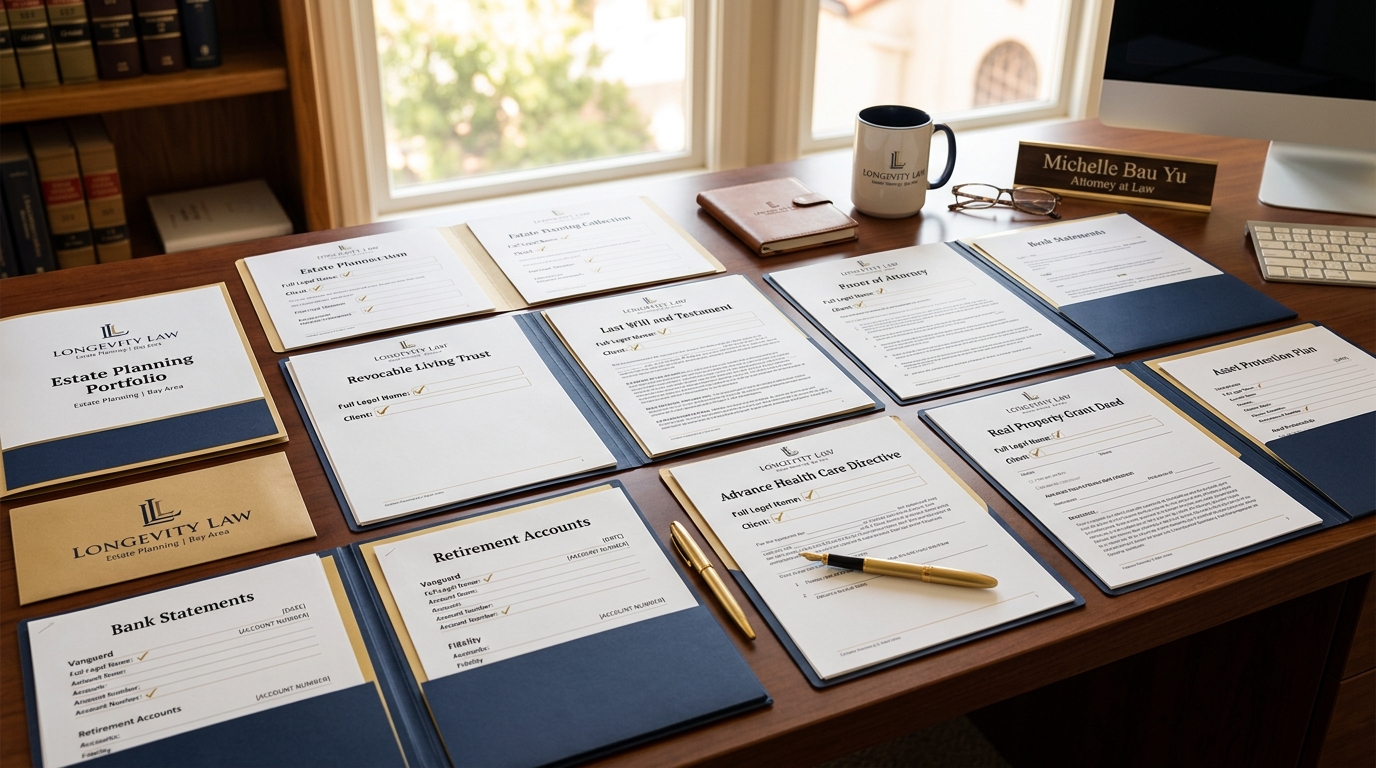
Estate planning is not limited to signing trusts and wills in California. Your plan should work alongside the way assets are titled and the beneficiary instructions that control certain accounts. Reviewing documents side by side can reveal inconsistencies before they become an administrative issue.
Start with government-issued photo identification, including a driver’s license, state ID, passport, and immigration documents where applicable. Then compare the name shown on those records with the names used on:
- Bank, brokerage, and retirement accounts
- Life insurance and annuity beneficiary forms
- Revocable trusts, wills, powers of attorney, and advance health care directives
- Real estate deeds, mortgage documents, and property tax records
- Business formation documents, LLC operating agreements, and ownership records
- Vehicle titles and other major asset records
- Prior marriage certificates, divorce judgments, legal name-change orders, and death certificates
For real estate in California, title matters. A deed may use a name format that differs from a current ID or trust, and the ownership language on the deed may also affect how a property is handled. Similarly, families with an LLC should make sure the ownership records align with the estate plan and any succession provisions. Longevity Law can help Bay Area clients consider these details as part of estate planning, real estate law, asset protection, and LLC formation work.
Beneficiary Forms May Control More Than a Will
Many people assume a will controls every asset. In practice, accounts with valid beneficiary designations may pass according to those forms, and assets titled in the name of a trust may be administered under the trust terms. Retirement plans, life insurance policies, payable-on-death accounts, and transfer-on-death registrations often have their own transfer rules.
That is why it is important to review the account owner’s name as well as the beneficiary’s name. A beneficiary designation that uses an outdated surname, an incomplete trust name, or an informal name can lead to follow-up questions. The same applies when a trust is named as beneficiary: the title and date of the trust should be reviewed carefully against the trust document.
Updating a will without reviewing beneficiary forms may leave important gaps. A coordinated estate plan looks at the full picture, including trusts, wills, account titles, deeds, and beneficiary designations.
Cross-Border Families May Face Added Complexity
Cross-border estate planning can require extra attention when a family has assets, citizenship ties, or beneficiaries in California, Asia, Canada, or other jurisdictions. Names may be shown in Chinese characters on one record and in Roman letters on another. A passport may use one transliteration, while a bank or property document uses a different spelling.
In addition, a document created abroad may require authentication, translation, or further review before a California institution can rely on it. Ownership rules, inheritance procedures, tax considerations, and recognition of estate-planning documents can vary by jurisdiction. Families should avoid assuming that a California trust or will automatically resolves every issue involving foreign property or overseas accounts.
Longevity Law provides multilingual support in English, Cantonese, and Mandarin, helping families communicate clearly about their documents and their goals. Attorney Michelle Bau Yu works with clients who need practical, culturally aware guidance for California-based and cross-border planning matters.
A Practical Name-Consistency Checklist
Set aside time to gather your documents and compare them carefully. The goal is not necessarily to make every record identical in every respect; rather, it is to understand meaningful differences, correct errors where appropriate, and preserve evidence that connects legitimate prior or alternate names.
- Identify your current legal name as shown on your primary government-issued ID.
- Make a list of prior legal names, alternate spellings, English names, Chinese names, and common variations you have used.
- Compare those names against your trust, will, advance directives, and powers of attorney.
- Review the title and date of any trust named on beneficiary forms.
- Check account registrations and beneficiary designations for bank, brokerage, retirement, insurance, and annuity accounts.
- Review deeds and business records, including LLC ownership documents and operating agreements.
- Keep marriage certificates, divorce decrees, name-change orders, and other connecting records in an organized, accessible place.
- Consider whether documents in another language may need an accurate translation or whether names in different scripts should be documented clearly.
- Tell your chosen trustee, executor, or trusted family member where your current plan and supporting records are stored.
- Revisit the review after a marriage, divorce, move, major asset purchase, business change, inheritance, or international relocation.
When a Clarifying Record May Help
Sometimes an institution may accept a straightforward explanation and copies of supporting documents. In other situations, a formal affidavit, updated record, or legal review may be appropriate. The right next step depends on the document, the institution, the assets involved, and the facts of the situation.
It is generally easier to address a known inconsistency while the account owner is available to provide information and sign updates. Waiting until after incapacity or death can limit options and place more responsibility on a trustee or family member.
How Longevity Law Can Help
As a Bay Area estate planning practice based in Los Altos, Longevity Law helps individuals and families create and review plans involving trusts, wills, advance directives, asset-protection considerations, business interests, and California real estate. Our approach is personal and practical: we help clients look beyond the signed documents to consider how assets are titled, how beneficiary instructions work, and how records may be understood during administration.
Every family’s facts are different, and this article is for general educational purposes only. It is not individualized legal advice, and no particular outcome can be promised. If you have noticed different versions of a name across your documents, a careful review can help you understand the questions to raise and the records to organize.
FAQ
Does a middle initial difference automatically invalidate a trust or will?
Not necessarily. A middle initial difference may be minor, but it can still lead an institution or court to ask for confirmation. The significance depends on the full circumstances, including the document language, other identifying information, and available supporting records.
Should I change every document to match my driver’s license exactly?
Not always. Some records may appropriately reflect a prior legal name or a name format required by the issuing institution. A review can help distinguish between a harmless formatting difference, a correctable error, and a variation that should be documented with supporting records.
What should I do if my Chinese and English names are different?
Keep clear records showing how the names relate to one another, including passports, identity records, and prior legal documents when available. It can also be helpful to review how names appear in Chinese characters and Roman letters across important financial and estate-planning records.
Can an outdated beneficiary designation create problems?
Yes. An outdated name, beneficiary, or trust reference can create confusion and may produce a result that does not reflect your current intentions. Beneficiary forms should be reviewed as part of a broader estate-plan review, particularly after major life changes.
When should I schedule an estate-planning review?
A review can be useful after marriage, divorce, a legal name change, a property purchase, formation of a business, a significant change in assets, or a cross-border move. It is also reasonable to review your plan periodically so your documents and account records remain coordinated.
If you would like to discuss a Bay Area estate planning consultation, contact Longevity Law to schedule a conversation. We welcome the opportunity to help your family review its planning documents and organize the next steps in English, Cantonese, or Mandarin.